Calming Activities for Anxiety That Don't Require Sitting Still
FreeReverseColoring · Editorial
Quick Answer
Most anxiety relief advice tells you to slow down and breathe. But for many people, stillness makes anxiety worse — the thoughts get louder when the body goes quiet. Active calming techniques like walking, gardening, cooking, and drawing work with your nervous system instead of against it. Drawing is particularly effective because it narrows your attention without requiring you to force calm.
Why Sitting Still Doesn't Always Help
Every article on anxiety management seems to offer the same advice: sit down, breathe deeply, practice mindfulness. And for many people, that advice works. But for a meaningful portion of those who experience anxiety, the instruction to be still produces the opposite of calm.
There's a physiological reason for this. Anxiety activates the sympathetic nervous system — the body's threat-response system. Heart rate increases, muscles tense, attention narrows to scan for danger. This is the state evolution built for running or fighting. When you try to counter it by sitting motionless and observing your thoughts, you're asking a primed, activated nervous system to do something it wasn't designed to do in that state.
Psychologists call the anxious stillness problem "rumination." When there's no physical or cognitive task to anchor attention, an anxious mind cycles through worries, hypothetical threats, and catastrophic scenarios. The thoughts don't quiet down just because the body is sitting. They often intensify.
Research published in Behaviour Research and Therapy found that rumination is one of the strongest predictors of anxiety maintenance — the more you try to monitor and suppress anxious thoughts, the more present they become. What helps instead is something called "attentional redirection" — giving your mind something specific to focus on that isn't the source of anxiety.
Movement and task-based activities do this naturally. They give the body somewhere to put its activation energy and give the mind a genuine focal point that isn't your worry list.
Active Calming Techniques That Actually Work
None of these activities requires special equipment, significant time, or existing skill. They share one characteristic: they engage the body and the mind simultaneously, which is precisely what anxious nervous systems respond to.
Walking with a purpose. Aimless walking can leave the mind free to ruminate. Walking with a simple perceptual task — noticing three things of each color you see, or identifying sounds by direction — uses attention more fully. The rhythmic, bilateral movement of walking also appears to have direct calming effects on the nervous system, which is why it's incorporated into therapies like EMDR.
Gardening and working with soil. Research from Bristol University found that contact with a specific soil bacterium (Mycobacterium vaccae) triggers the release of serotonin — the same mechanism targeted by many antidepressants. This happens through skin contact and inhalation. Beyond the chemistry, gardening provides immediate sensory feedback: soil temperature, plant resistance, the smell of earth. That density of sensory input is hard for anxious thoughts to compete with.
Cooking and baking. The combination of measurement, sequencing, and sensory engagement makes cooking one of the more complete anxious-mind redirectors. You have to track multiple things at once — temperature, timing, quantities — which doesn't leave much cognitive space for worry. The result also provides a concrete sense of accomplishment, which directly counters the helplessness component of anxiety.
Cleaning and organizing. There's a reason anxious people often end up cleaning their homes during a bad episode. Creating visible order in the physical environment satisfies a deep need for control that anxiety undermines. It's best treated as a tool rather than a compulsion — one session of purposeful tidying, not an hours-long project driven by distress.
Drawing and visual art. Drawing is unusual among these activities because it doesn't require movement around a space — but it still provides the narrow attentional focus and sensory engagement that distinguishes active calming from passive rest. The hand-eye coordination loop, the immediate visual feedback, and the requirement to observe carefully all anchor the mind in the present moment in a way that's difficult to achieve through effort alone.
"The goal isn't to stop feeling anxious. It's to give your nervous system somewhere else to put its energy — and your mind something real to look at."
How Drawing Specifically Helps Anxiety
Drawing occupies a distinctive position in the anxiety toolkit because of how it manages attention. Most calming activities work by redirecting attention to the body (breathing exercises), the environment (walking), or a task (cooking). Drawing does something slightly different: it creates a narrow observational channel that requires genuine looking.
When you draw from observation — even if it's just looking at a subject and trying to translate it onto paper — you're using a part of your brain that is essentially incompatible with anxious rumination. The visual processing required to translate three-dimensional objects into marks on a flat surface requires specific, present-tense attention. You have to look at the actual curve of a leaf, the actual shadow under a cup. Not a remembered or imagined version. The actual thing, right now.
This is sometimes called "the zone" or flow state in casual language, but it has a clinical corollary: a state of absorbed attention in which self-referential thought quiets naturally. The mind isn't forced quiet — it's occupied.
Dr. Girija Kaimal, a researcher at Drexel University who studies art-making and neuroscience, has found that even brief sessions of visual art-making reduce cortisol levels measurably. The effect doesn't require artistic training or skill. It requires engagement.
The other thing drawing does is provide immediate, controllable feedback. Anxiety often involves a sense that things are out of control and outcomes are uncertain. A line on paper is something you made, something that responds directly to your hand. That small, immediate loop of cause and effect is a corrective to the helplessness anxiety tends to generate.
Reverse Coloring as an Anxiety Tool
For people dealing with anxiety, one of the most common barriers to drawing is the blank page. Not because they can't draw — but because starting something from nothing requires a kind of creative confidence that anxiety specifically erodes. You pick up the pen and immediately ask: what should I draw? Is it good enough? What if it looks wrong?
This is where the reverse coloring technique is structurally different from conventional drawing exercises.
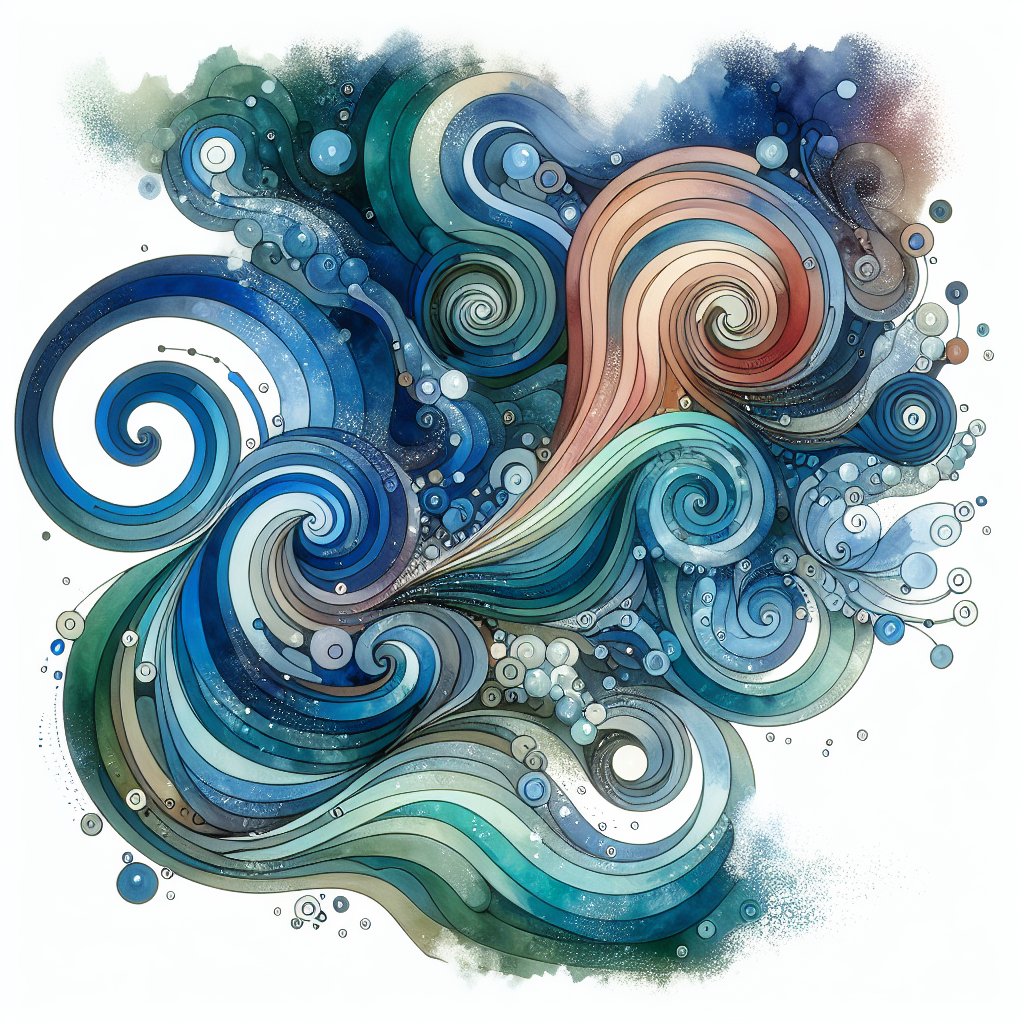
With reverse coloring, the image arrives already complete in color. You receive a watercolor background — rich, finished, visually engaging — and your task is to add outlines, shapes, and forms on top of or within it. There is no blank page. There is no "what should I draw" question. The colors are already there, suggesting forms, inviting observation. Your eye finds shapes in the watercolor naturally, the same way it finds animals in clouds.
This removes what therapists call the "initiation barrier" — the difficulty of starting a creative task when you're not sure it's going to be good enough. With reverse coloring, you're already looking at something beautiful. You're responding to what's already there rather than generating something from nothing.
For anxiety specifically, this matters for a second reason: the activity is bounded. There's a defined object in front of you (this watercolor image), a defined tool in your hand (a pen or pencil), and a defined task (find and draw the forms you see). The ambiguity that blank-page drawing creates — which is exactly the kind of ambiguity that anxious minds find difficult — is substantially reduced.
FreeReverseColoring.com delivers a new watercolor design to your inbox each week, free. There are no prompts to follow, no technique requirements, no skill level needed. You print the image and begin. That's the entire process.
Swirling Serenity

Aqua Fantasia
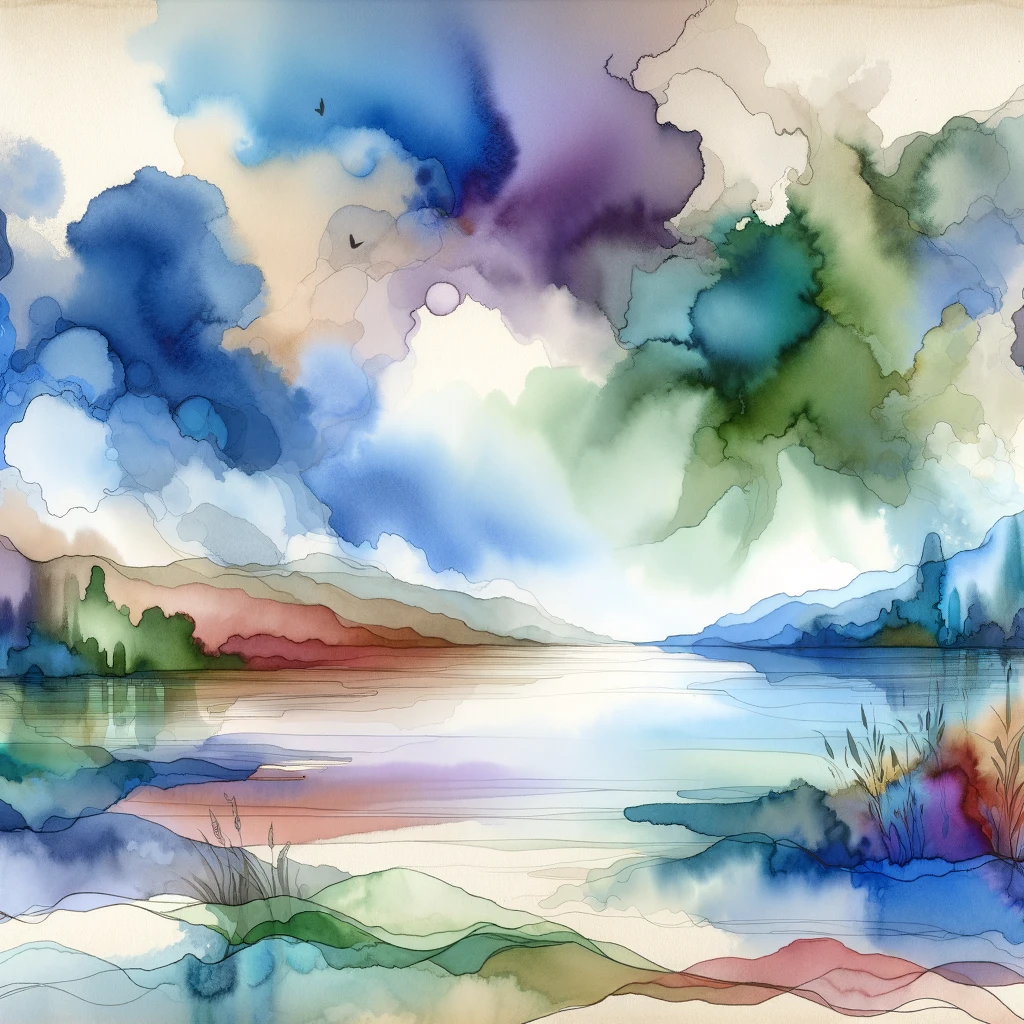
Tranquil Hues of Serenity
Top tip
If you find that anxiety makes it hard to begin, set a timer for five minutes before you start. Tell yourself you only have to do five minutes. Almost always, five minutes in, the state has shifted enough that you want to continue. The activation energy for starting is the real barrier — not the activity itself.
Building Your Personal Calming Toolkit
No single technique works for everyone, and no single technique works for the same person in every situation. The anxiety you feel before a difficult conversation is different from the anxiety that wakes you at 3 a.m. Different techniques are better suited to different contexts.
The practical goal is to build a small toolkit — three to five activities you know work for you — so that when anxiety rises, you're not trying to figure out what to do. You already know.
A useful toolkit has range. Include at least one activity that requires you to move (walking, gardening, yoga), one that is task-based and outcome-oriented (cooking, organizing, craft projects), and one that is purely sensory and absorbing (drawing, music, tactile work with materials).
When you're building this toolkit, it helps to pay attention to how an activity affects you during and after — not just whether it "should" be calming based on what you've read. Some people find cooking highly effective and find drawing frustrating. Some people find the opposite. The goal is to learn your own nervous system, not to implement someone else's protocol.
Drawing and reverse coloring tend to be accessible starting points because they require minimal equipment and can be done anywhere. A printed image, a pen, and twenty minutes is enough. But they're a starting point, not a prescription.
For a deeper look at what creative activities can offer beyond anxiety relief, see our article on what reverse coloring is and how it works. And if you're interested in the broader connection between art-making and mental health, art therapy activities you can do at home covers therapeutic creative practices in more detail.
Try a calming creative activity this week
Get a free watercolor design in your inbox — print it, pick up a pen, and try 20 minutes of reverse coloring. No skill required, no blank page to face.
Free forever. No spam. Unsubscribe anytime.
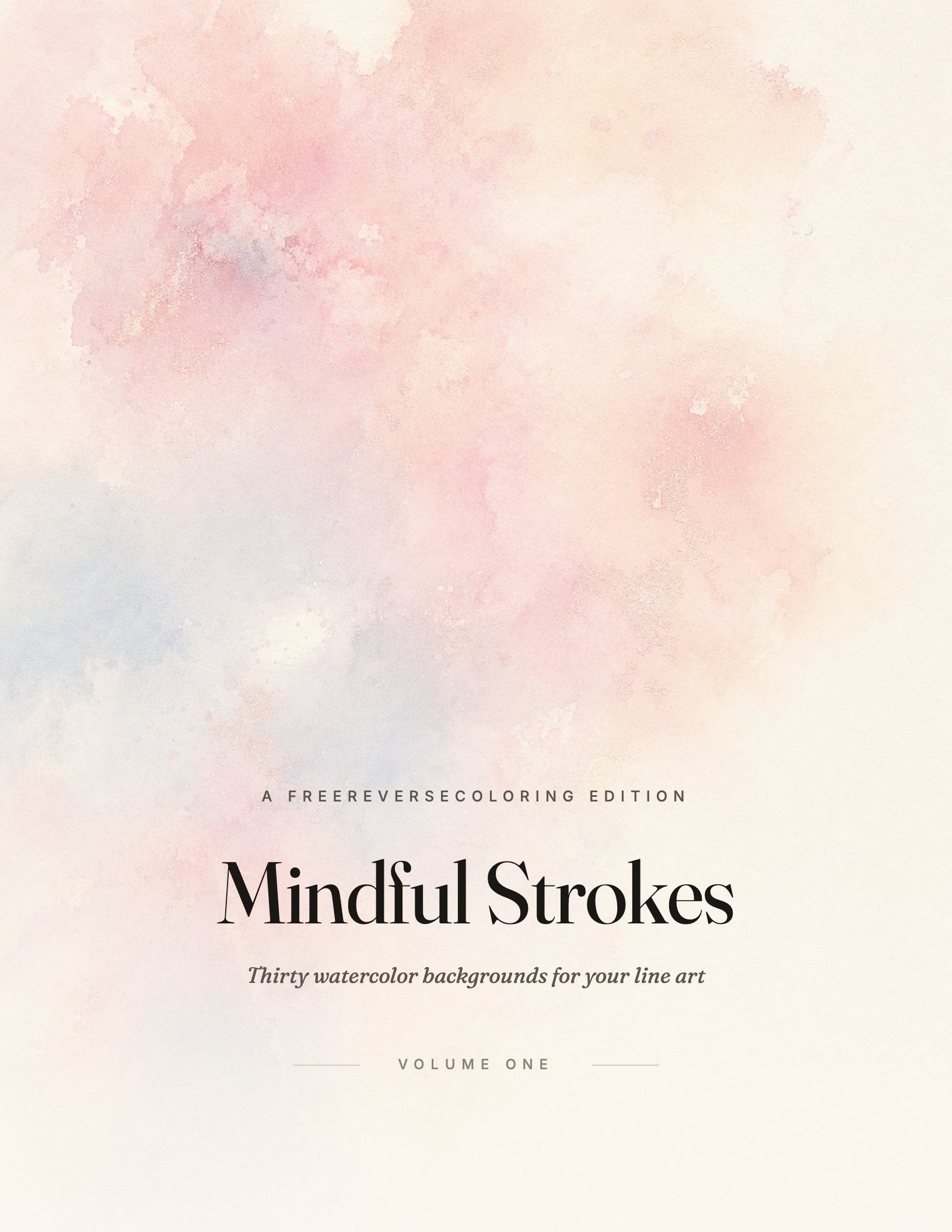
Prefer a book you can keep by the bed?
Mindful Strokes — Volume One bundles 30 of our calmest watercolor backgrounds with 50 gentle drawing prompts into one printable PDF. A one-time $9 download, made for exactly these 20-minute evening sessions. Free 8-page sample available.
Frequently Asked Questions
Does drawing really help anxiety, or is it just a distraction?
The distinction between "helping" and "distracting" is less clear than it might seem. Cognitive behavioral therapists use the term "attentional redirection" for techniques that shift focus away from anxious rumination, and this is considered a legitimate anxiety management strategy — not a mere distraction. The research on art-making and cortisol reduction suggests that drawing produces measurable physiological changes, not just a temporary shift in where you're looking. That said, drawing is most useful as one tool among several, not as a substitute for addressing the sources of chronic anxiety.
I've tried drawing before and felt frustrated because I can't draw well. Won't that make anxiety worse?
Yes, if the drawing task involves self-evaluation. The key is choosing activities that don't create performance pressure. Reverse coloring works well for this reason — there's no defined correct outcome, no blank page to fill from nothing, and the image is already visually satisfying before you add anything. If conventional drawing has felt frustrating, that's worth noting as signal: not that you're bad at it, but that the specific task generated performance anxiety rather than relief. Try something more bounded.
How long does a drawing session need to be to help with anxiety?
Research suggests that meaningful cortisol reduction can occur in sessions as short as 20-45 minutes. Anecdotally, most people notice a state shift within the first 5-10 minutes once they've gotten past the initiation barrier. Starting is usually the hardest part. If you wait to feel calm enough to begin, you may wait a long time — it tends to work better to begin and let the activity shift the state.
Can these activities replace therapy or medication for anxiety?
No. Activities like drawing, walking, and gardening are tools for managing anxiety symptoms in the moment — they are not treatments for anxiety disorders. If your anxiety is significantly affecting your quality of life, relationships, or ability to work, please consult a mental health professional. Cognitive behavioral therapy (CBT) and acceptance and commitment therapy (ACT) have strong evidence bases for anxiety disorders. These activities can complement professional treatment, but they are not substitutes.
What if I try to draw and can't stop my mind from racing?
This is common, especially early in a session. The mind doesn't quiet immediately just because the hands are busy. The usual experience is that within 5-10 minutes of sustained engagement with the drawing task — really looking at the image, making marks, responding to what you see — the mental noise decreases somewhat. If you find the racing thoughts are persistent even after a full session, that's useful information: drawing may not be the right tool for your particular anxiety profile, or you may be in a high-enough-activation state that a more physical activity (walking, vigorous exercise) would be a better first step.